
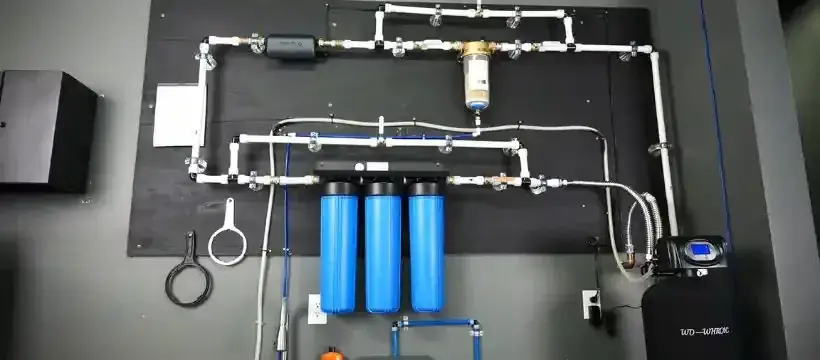
Water softeners and filters change what comes out of your tap, but only the right one fixes anything. In Sapulpa, OK the first step is to test your tap before you buy equipment. A water softener swaps the minerals that cause scale for sodium or potassium, a filter removes particles or chemicals, and reverse osmosis forces water through a membrane at one faucet. Licensed plumbers install all three as a planned job.
Answered first
Quick answers before the details
Test your tap with a strip kit for a quick read or send a sample to a lab for a firm one. Also ask the City of Sapulpa Water Treatment Plant for the latest annual water quality report. We do not state a number because we have not confirmed a current figure.
It depends on what the test shows and what bothers you. Scale calls for a softener, taste calls for a carbon filter or under-sink unit, and particles call for a sediment filter. Some homes need two.
No. A softener exchanges hardness minerals, and it does not disinfect or remove most contaminants. Drinking water treatment is a separate question, so ask for the specifics of any product.
Start with a test of your tap
The City of Sapulpa Water Treatment Plant supplies drinking water drawn from Sahoma Lake and Skiatook Lake, per the city's 2025 Consumer Confidence Report. We do not quote a hardness number for Sapulpa because we could not confirm a current one. Plumbing inside your home can also change what reaches the faucet.
So test it yourself. Ask the City of Sapulpa Water Treatment Plant or Utility Billing for the latest annual water quality report. Then test the tap at your kitchen sink, before any treatment, using a strip kit or a lab.
Strips versus a lab test
- Test strips cost little, give a rough reading in a minute, and are fine for a first look at hardness.
- A certified lab test measures hardness, iron, pH and more, and is the better basis for a purchase.
- Run the tap for a minute before sampling so you are not testing water that sat in the pipe.
- Test the cold side, since hot water can pick up minerals from the tank.
Results usually come as grains per gallon or milligrams per liter. One grain per gallon is about 17 milligrams per liter, and a plumber or lab can tell you how your reading compares with commonly used softness scales.
Signs your water may be hard
- White crust on faucets, showerheads and the kettle.
- Spots on dishes and glassware, even after the dishwasher.
- Soap that does not lather, or a film on the tub.
- Dry skin or stiff laundry.
- A water heater that rumbles as scale builds up inside the tank.
These signs point toward hardness, but they are not proof. A test tells you whether to buy anything.
Want a water treatment plan?
A dispatcher is on the line 24/7. Nobody here will pressure you into a repair, and the price is agreed before work starts.
Softener, filter or reverse osmosis: what each one does
| System | What it addresses | What it does not |
|---|---|---|
| Salt-based softener | Calcium and magnesium scale | Does not remove chlorine taste or most contaminants |
| Whole-house carbon filter | Chlorine taste and odor | Does not soften water |
| Sediment filter | Sand, silt and rust particles | Does not touch dissolved minerals |
| Reverse osmosis at one tap | Many dissolved solids at the drinking tap | Slow, wastes some water, not whole-house |
| Combination | Different jobs in sequence | Needs space and a plan |
Be honest about what you want solved. If the complaint is scale on fixtures, a softener fits. If it is taste, a carbon filter or an under-sink unit fits. If you are worried about a specific contaminant, a lab test comes first and the equipment follows.
What to ask before you buy
Filtration products differ a lot, and marketing claims are loose. Ask these questions of any seller, including us.
- 1What does it remove, specifically?Ask for the contaminants by name, not "purifies water."
- 2Is it independently certified?Look for NSF/ANSI standards, such as 44 for softeners, 53 for filters and 58 for reverse osmosis, and ask to see the listing for the exact model.
- 3What does it cost to run?Salt, filter cartridges, membranes and water used for regeneration all count.
- 4What maintenance does it need?Ask how often filters change and who does it.
- 5How big is it?Ask for the dimensions and the drain, water and power it needs.
How installation works
A whole-house unit goes on the main water line, usually near where the line enters the house and ahead of the water heater. A plumber installs a bypass valve so you can isolate the unit for service, connects inlet and outlet, and runs a drain line for the backwash or regeneration water, to a floor drain or standpipe with an air gap. Most softeners also need a nearby outlet for the control head.
Installation also means checking pressure, flow and the pipe the unit connects to. Plumbing permits in Sapulpa are separate from building permits and go through Building Inspections for licensed, city-registered contractors, so ask City of Sapulpa Building Inspections whether your installation needs one. The plumber can also fold this into a broader plumbing installation project.
Where it can go
Garages, utility rooms and basements work well. Avoid spots that freeze, and leave space around the tank for salt refills and service. A tankless water heater may benefit from softened water because scale is hard on narrow heat exchangers.
Maintenance you will actually do
- Check the salt level monthly and top it up before it runs low.
- Break up any salt bridge that forms a crust over empty space.
- Replace filter cartridges on the schedule in the manual.
- Clean the brine tank once a year or as the manual says.
- Check the bypass valve and the drain line for leaks.
When you do not need one
Not every house benefits. If a test shows soft or moderate water, a softener adds cost and maintenance for little gain. If the only complaint is chlorine taste, a small carbon filter may be enough. People on low-sodium diets should talk with a doctor before drinking softened water. Homes on septic should check the manufacturer's guidance on regeneration discharge.
Before spending money on equipment, rule out a plumbing problem. Poor pressure or discolored water can come from a failing pipe, in which case water line repair may be the real fix.
What decides the price of water treatment
A clear price comes before work starts. The factors below move the number.
A salt softener, whole-house filter and reverse osmosis system all differ in price. Capacity matters, so a large family needs a bigger unit.
Iron, high hardness or other issues can call for pretreatment, which adds components.
A unit near the main line with a nearby drain is simple. A long run or a finished space adds labor.
A floor drain and outlet nearby keep the job simple. Adding either is extra work.
Salt, cartridges and membrane replacement add up, so compare running costs, not just the purchase price. Call for your real number.
Insurance and landlord notes
Homeowner's policies generally do not cover water treatment equipment as a repair item, but a leak from a new unit may be treated like any other leak. Check your policy. Renters should get landlord approval before adding anything to the main line.
Planning water treatment in Sapulpa
Sapulpa Express Plumbing serves Sapulpa, Kellyville, Mounds and Glenpool. Homes near Mounds or outside city limits may be on a private well or a rural water district, which can have very different water than city supply, so test first wherever you live. Bring your test results to the first call.
Sources and standards
Softeners, filters and reverse osmosis units are tested under NSF/ANSI 44, 53 and 58, and the NSF listing for a model shows exactly what it was tested to do. Permit and edition questions belong to the city office, and license questions to the state board.
Water softener and filtration questions
Plumbing permits in Sapulpa are separate from building permits and are requested by state-licensed, city-registered contractors. Call City of Sapulpa Building Inspections to ask if your installation needs one.
Yes, some. The membrane sends a portion of the water to the drain, and the amount varies by model. Ask the seller for the ratio.
Some people do, but tying into the main line, installing a bypass and plumbing a drain with an air gap are where mistakes cause leaks. A licensed plumber can do it and check for leaks.