
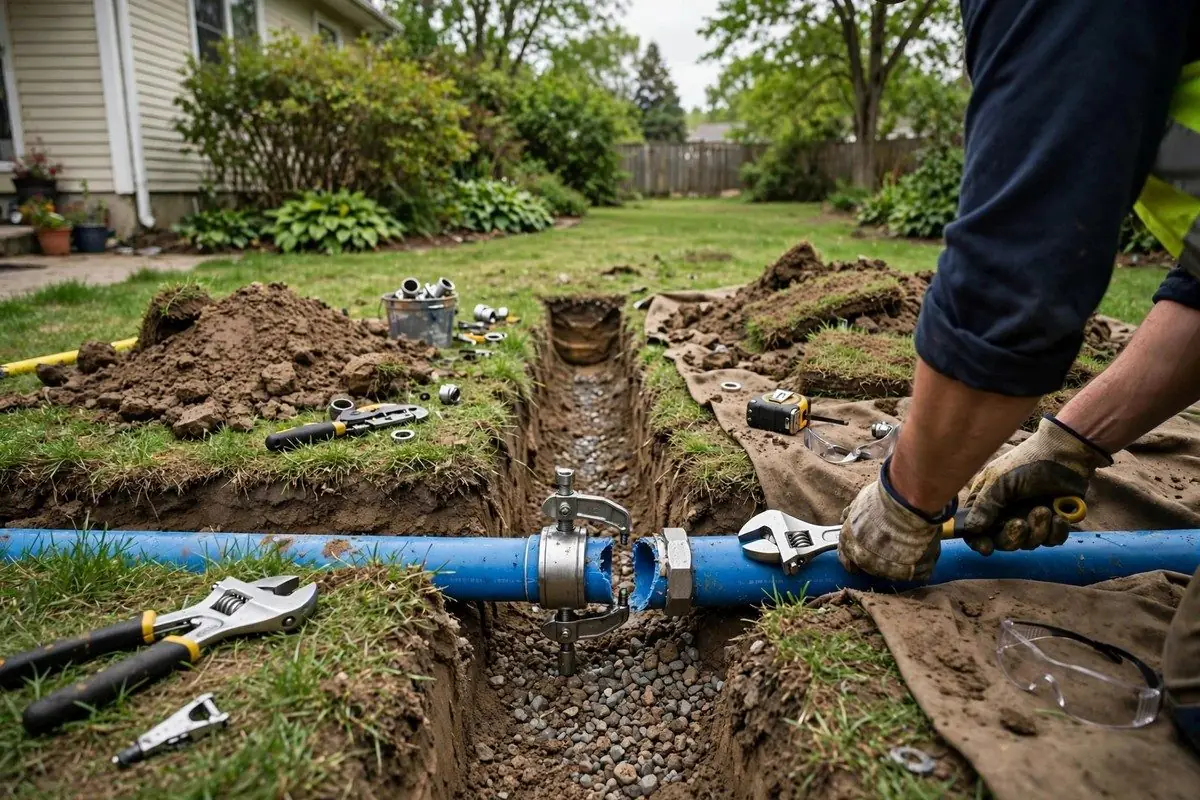
Water line repair in Sapulpa, OK means fixing the buried supply pipe that brings water from the meter to your house. If water is bubbling up in the yard or pressure has dropped to a dribble, call our 24/7 emergency line and a dispatcher will arrange a licensed plumber. Until then, close the main shutoff valve inside the house and keep the area around the wet spot clear so the plumber can see it.
Answered first
Quick answers before the details
Yes. The 24/7 emergency line is answered at all hours, including weekends. A dispatcher asks where the water is coming from and whether you can reach the shutoff, then arranges a licensed plumber for a same-day appointment when available.
Turn off every fixture and appliance, including ice makers and irrigation, and watch the meter. If the dial or low-flow indicator keeps moving, water is leaking. Photograph it, wait an hour without using water, and compare.
We cannot state where the city's responsibility ends. Ask City of Sapulpa Utility Billing or Utility Maintenance for your address. A plumber can repair the section on your side of that point.
Signs the buried supply pipe is leaking
A service line leak hides under soil, so the clues are indirect. These are the ones homeowners describe most often.
- The meter dial or low-flow indicator keeps moving with every tap, appliance and toilet off
- A soft, wet or unusually green patch in the yard, or a sunken strip of ground
- Pressure that has dropped at every faucet, not only one
- Water that runs brown, cloudy or sandy after a repair or a pressure drop
- The sound of running water in a quiet house
- A water bill that jumped without a change in how you live
Check the meter test first. Turn off everything that uses water, then watch the meter. If the dial still turns, water is escaping somewhere between the meter and the fixtures. Your leak detection options appear on our leak detection page.
Water line emergencies that cannot wait for morning
Call right away when a line is visibly spraying, when the yard is flooding, when the house has lost pressure completely, or when water is pooling near the foundation or entering a crawlspace or basement. Those are active failures, and they are cheaper to stop early.
A slow, steady drip into soil is less dramatic but still worth a prompt visit. The soil around a leak can wash out, and a washed-out pocket is a common reason a repair gets larger. The 24/7 line works for both situations, and same-day appointments are available when schedules allow. After-hours calls get the same questions as daytime ones: where is the leak, can you reach the shutoff, is there water inside.
Think your service line is leaking?
A dispatcher is on the line 24/7. Nobody here will pressure you into a repair, and the price is agreed before work starts.
Who is responsible for which section of pipe
Three parts matter here: the city main in the street, the meter, and the pipe from the meter to your house. The city's Utility Maintenance Department maintains city water and sewer lines. Where the city's responsibility ends and yours begins on a service line is not something we can state from here.
Ask City of Sapulpa Utility Billing or Utility Maintenance where the city's responsibility ends at your address, and ask before any digging. A plumber can fix what is on your side of that point. If the leak is at or before the meter, the city is the one to call.
Write down the answer, the date and the name of the person who gave it. That note helps if there is a disagreement about who pays.
How a plumber traces the leak
Digging at random is how yards get torn up for nothing. A visit generally begins with a meter check and a pressure gauge on a hose bib to see how pressure behaves with the house shut off.
If the line is leaking, the plumber narrows the location without opening the lawn. Acoustic listening equipment picks up the hiss of escaping water through the ground. A correlator uses sensors at two points to calculate the distance to the sound. Where the pipe is metal, a tracer signal can follow the run. On a plastic line, the plumber may use a tone on a tracer wire, if one was buried with the pipe.
Once a likely spot is found, a small test hole confirms it. Then the options are discussed. Our slab leak repair page covers the version of this problem that sits under concrete.
Repair or replace the service line
The choice is rarely about the leak you have. It is about the pipe you have.
| Situation | Usually points to | Trade-off |
|---|---|---|
| One break from a rock, shovel or frost | Spot repair with a new section and fittings | Quickest and least digging, but the rest of the pipe stays as is |
| Old pipe with repeated leaks | Replacement of the full run | More digging up front, fewer repeat visits |
| Pipe that has corroded inside and restricts flow | Replacement | Corrects low pressure, which a patch cannot |
| Leak at a fitting or at the house entry | Fitting or entry repair | Depends on access to the wall or footing |
| Line under a driveway or tree roots | Replacement route chosen to avoid the obstacle | Trenchless methods may apply where the site allows |
A patch is reasonable when the pipe around it is sound. A second leak within a few feet usually means the pipe is tired, and the plumber should say so.
Pipe materials: copper, PEX and polyethylene
Three materials cover most new service lines.
Copper
Copper is durable, handles heat and resists damage from sunlight and rodents. It can corrode in aggressive soil or water and costs more than plastic, and long runs need joints that are soldered or fitted with compression couplings.
PEX
PEX is flexible cross-linked polyethylene. It bends around corners with fewer joints, tolerates freezing better than rigid pipe, and joins with crimp or expansion fittings. It must not sit in sunlight, and the product must be rated for underground potable water use.
Polyethylene
Polyethylene pipe is often used for long runs of buried service. It comes in coils with few joints and resists corrosion. Check the manufacturer's pressure rating and the fittings it requires, because not every fitting suits every brand.
Whatever the material, ask for the manufacturer's installation instructions and for pipe labeled for potable water. If your home has older galvanized pipe inside, see our repiping page for the larger picture.
Low water pressure and dirty water
Low pressure at every tap is a whole-house issue, and the service line is one of several suspects. A leak upstream steals pressure. A corroded line chokes it. A partly closed main valve or a failed pressure regulator, if the house has one, does the same thing.
Start with the easy checks. Make sure the main valve at the house is fully open. Compare hot and cold, since low pressure only on the hot side points to the water heater. Try a hose bib near the meter, which tells you whether the problem sits before or after the house piping.
Brown or sandy water after pressure drops can be sediment disturbed by a break or a main flush. Run a cold tap for a couple of minutes to see if it clears. If it does not, or if the water smells, call us and avoid drinking it until it clears. The city's most recent Consumer Confidence Report is the place to look for official water quality information.
High bills and leak adjustments
A buried leak can run for a long time before anyone sees a puddle, so the first sign is often the bill. The city's Utility Billing page says staff provide leak adjustments. It does not describe eligibility or process, so call City of Sapulpa Utility Billing at City Hall, 425 E. Dewey Ave., and ask what they need from you.
Keep the plumber's written findings, the repair invoice and a photo of the repaired section. Those records show when the leak was found and when it was fixed, which is what a billing office tends to ask about. We cannot promise any adjustment, since that decision belongs to the city.
What decides the price of water line repair
We do not list dollar figures here. A real number depends on the line, and the plumber on site will state a clear price before work starts. These are the factors.
A spot repair swaps a few feet. A full replacement covers the meter to the house. The longer the run, the more pipe, fittings and trench time.
Deeper pipe means more digging and shoring. Rocky or clay-heavy ground slows the work. Wet soil around a leak adds cleanup.
Grass restores easily. A driveway, sidewalk, patio, fence or mature tree root zone adds cutting, hauling, rebuilding or rerouting.
Copper, PEX and polyethylene differ in material cost and in fittings. A connection at the meter or at the house wall may take extra fittings and careful work.
Most plumbing work inside city limits must be done by a state-licensed contractor registered with the city. Plumbing permits go through the Building Inspections office at the City Hall Annex, and minor repairs are the main exception. If your job needs a permit, it should be in the quote.
Does insurance cover a water line leak?
Policies differ widely. Many cover sudden and accidental water damage inside the home but treat a worn buried pipe, and the cost to dig and replace it, differently. Some insurers offer a service line endorsement as an add-on. Check your policy or ask your agent.
If you rent, tell your landlord. Document the leak with photos, the meter reading, and the plumber's report.
While you wait for the plumber
- Close the main shutoff valve inside the house, usually near where the pipe enters
- Take a photo of the meter and note the reading and time
- Keep children and pets away from soft, wet ground near the leak
- Turn off the water heater if the house is losing water and you cannot stop it
- Move valuables off wet floors and basements
- Note any pressure or color changes with times
- If water is near a breaker panel or outlet, stay out and call us
Serving Sapulpa and nearby
We dispatch from 215 E Dewey Ave and work across Sapulpa. The same line covers Glenpool, Kellyville and Mounds. The city says Sapulpa's drinking water comes from Sahoma Lake and Skiatook Lake, treated at the city's plant, so a pressure or quality issue can sometimes come from the system rather than your pipe. Ask Utility Billing or Utility Maintenance if neighbors report the same thing.
What to do when the water line leaks
- Close the house main shutoff and see if the meter keeps moving afterward.
- If the meter still moves with everything off, the leak is probably between the meter and the house, and the plumber needs to know that.
- Do not dig or probe the yard until 811 has marked buried lines.
- Keep people and pets away from soft, wet ground and water running toward a foundation or driveway.
- Call Utility Billing about a leak adjustment after the repair, and keep the plumber's written findings.
Sources and standards
Water service line work follows the UPC or IPC as adopted locally, with pipe and fittings certified to NSF/ANSI 61, and call 811 before any digging. The Oklahoma Construction Industries Board license lookup confirms a plumber, and Building Inspections answers permit questions.
Water line questions
The city's Utility Billing page says staff provide leak adjustments. Call Utility Billing at City Hall and ask what they require. Keep your repair invoice and the plumber's findings.
All three work when installed correctly and rated for potable underground use. Copper is durable but pricier, PEX is flexible and tolerates freezing, polyethylene suits long runs. The plumber should explain the fit for your site.
No. A partly closed main, a failing regulator or corroded pipe also cut pressure. A meter test and a few quick checks help separate those from a leak.