
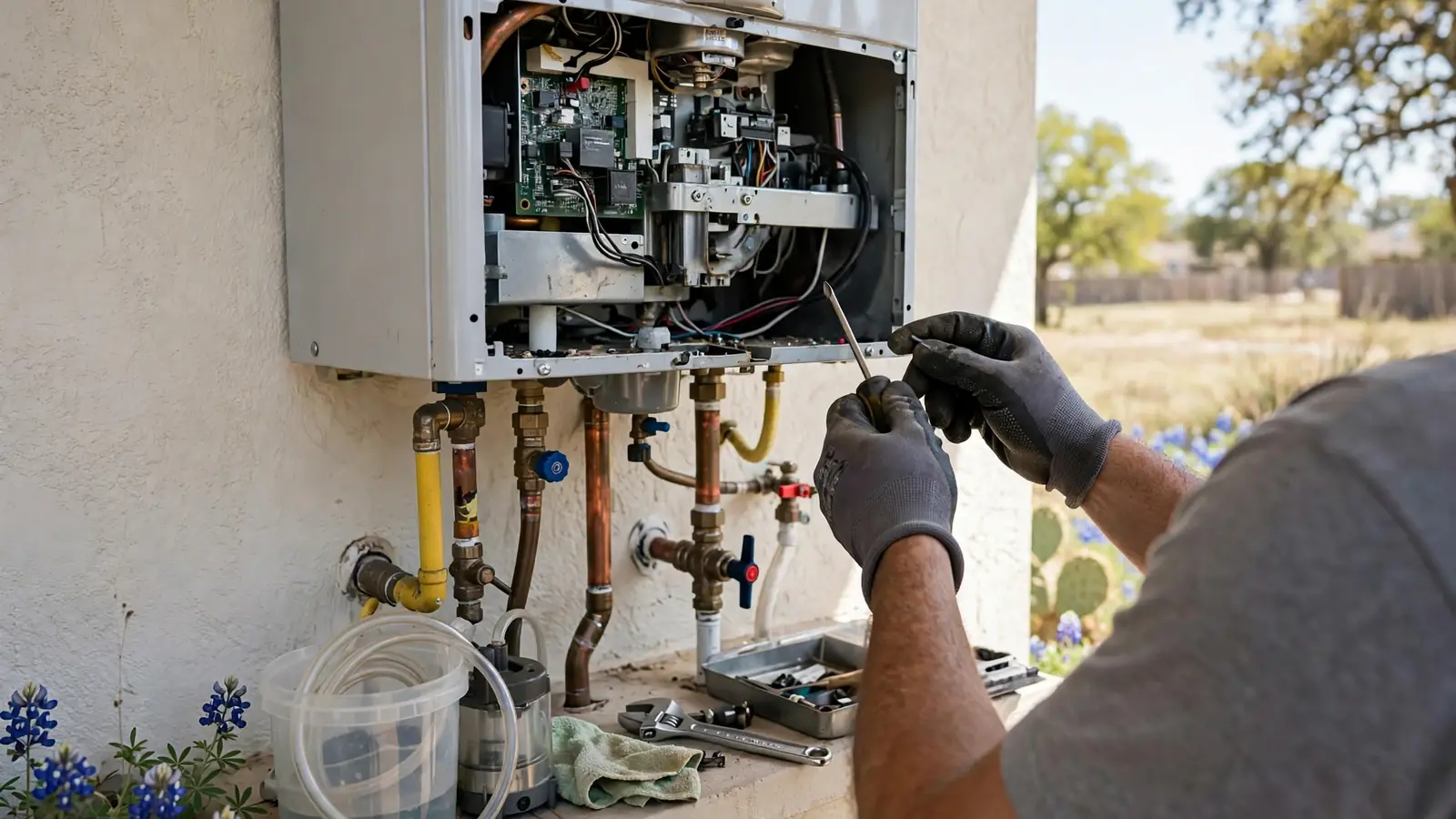
A tankless water heater heats water only when a tap opens, using a gas burner or electric elements and a heat exchanger instead of a stored tank. Tankless water heater work in Sapulpa, OK covers new installs, repairs when a unit shows an error code or runs lukewarm, and the yearly flush that keeps scale off the heat exchanger.
The units reward good planning. An undersized gas line, a poor vent route or ignored scale causes most of the trouble people report.
Answered first
Quick answers before the details
Follow the manufacturer's manual for your model. Many call for a yearly flush, and harder water means more often. Ask your water utility about hardness and test your tap.
It depends on the brand and model, and the same number can mean different faults. Check the manual for your exact unit, then call if the code returns after you check the gas, water and vent.
Yes, often. The gas line, vent and permit need planning. Plumbing permits go through City of Sapulpa Building Inspections by state-licensed, city-registered contractors.
How a tankless unit works and where it goes wrong
When you open a hot tap, a flow sensor detects water moving, the control board lights the burner or energizes the elements, and the heat exchanger raises the temperature to the setpoint. A thermistor reads outlet temperature and the board adjusts the flame or power to match. A fan pulls combustion air through on gas models.
That chain has several weak points: a flow sensor clogged with debris, a scaled heat exchanger, a failed igniter or flame rod, a weak fan, or a blocked vent or condensate drain. Because the unit runs only on demand, any shortfall in gas, flow or air shows as cold water, not just a slow recovery.
Installing a tankless unit
A tankless install is not a tank swap. The unit mounts on a wall, so the old tank's footprint is no longer the starting point. The plumber works through the gas supply, venting, water lines, drain, electrical outlet, and clearances in the manufacturer's manual.
- 1Check the load.Add up the flow of fixtures that may run together and pick a unit whose gas input and flow rating cover your winter temperature rise.
- 2Confirm the gas line.Verify pipe size, length and total demand. Upsize the branch if needed.
- 3Plan the vent.Choose a direct-vent or concentric route through a wall or roof, within the manual's length and elbow limits.
- 4Set the water side.Install isolation valves with service ports, a pressure relief valve where the manual calls for it, and a condensate line on condensing models.
- 5Pull the permit and inspect.Plumbing permits in Sapulpa go through City of Sapulpa Building Inspections, requested by state-licensed, city-registered contractors.
- 6Commission and teach.Test combustion if required, check flow and setpoint, and show you the error display and the service ports.
If you are weighing this against a tank, water heater installation lays out the planning questions for every type.
Talk through your tankless plan
A dispatcher is on the line 24/7. Nobody here will pressure you into a repair, and the price is agreed before work starts.
Condensing and non-condensing models
Non-condensing units exhaust hot flue gas at high temperature and typically need stainless or special vent pipe. Condensing units add a second heat exchanger to pull more heat from the exhaust, so the gas leaves cooler and can use plastic vent pipe such as approved PVC, CPVC or polypropylene, per the manual. The tradeoff is condensate, an acidic liquid that must drain to a floor drain or a condensate neutralizer and not freeze.
Condensing models are more efficient but cost more up front, and the condensate drain adds a requirement for the install spot. Check the manufacturer's manual for approved vent materials and neutralizer rules.
Gas supply and venting upgrades
Most tank-to-tankless conversions need the gas line looked at. A tankless unit at full fire demands far more gas than a tank burner, and an older half-inch branch is often too small once you add the furnace, range and dryer on the same line. The plumber measures the run, counts fittings, and checks the total demand against sizing tables, then upsizes pipe and adds a drip leg if needed.
The vent differs too. A tank may use a metal flue to a roof, while tankless units use their own sealed vent in specific diameters. Do not reuse the old flue without checking the manual, and keep clearances from windows, doors and meters as stated there.
Descaling and flushing
Mineral scale forms inside the heat exchanger as water is heated, and it is the top cause of error codes and weak heat on a tankless unit. Flushing removes it before it hardens.
- Shut off the gas or power and close the water isolation valves.
- Connect hoses to the service ports and circulate a descaling solution through the heat exchanger with a small pump. Use the solution type the manual approves, often a food-grade white vinegar or a manufacturer product.
- Circulate for the time the manual states, then flush with clean water.
- Clean the inlet water filter screen, then reopen the valves and check for leaks.
- Reset the maintenance code if your unit has one.
Frequency depends on your water and the maker's manual. Harder water means shorter intervals. Sapulpa's city water report does not publish a current hardness figure, so test your tap or ask the city's water utility, and consider water softener and filtration to slow the scale.
Minimum flow, cold-water sandwich and recirculation
Tankless units need a minimum flow rate to fire, often a fraction of a gallon per minute. A low-flow faucet or a trickle from a half-open tap may not trigger the burner, so the water stays cold. That is a design limit, not a defect.
The cold-water sandwich is a short blast of cold between two hot flows when you shut off and reopen a tap. A recirculation pump or a small buffer tank on some models reduces it. Long pipe runs also delay hot water, since the pipe has to clear its cold standing water first.
Error codes and what to do
Error codes are brand specific, and the same number can mean different things across makers. The display may show a number or a flashing pattern. Look up the code in your manual or on the manufacturer's site for your exact model before you act.
Common families are ignition failure, flame loss, overheat, vent blockage, flow sensor fault, thermistor fault and a scale or maintenance reminder. Simple steps that are safe: check that the gas valve and water valves are open, reset power once, and look at the vent termination for blockage. Do not open sealed combustion parts, and do not keep resetting a unit that locks out. If you smell gas, leave, call 911, then call Oklahoma Natural Gas at 800-458-4251.
Maintenance schedule
Follow the manufacturer's manual for exact intervals, and use the list below as a typical outline of the tasks.
| Task | Typical timing |
|---|---|
| Clean the inlet water filter screen | Per manual, often at each service |
| Flush and descale the heat exchanger | Per manual, sooner with harder water |
| Check vent, termination and condensate drain | At each service |
| Inspect gas connections and burner | Per manual, by a licensed plumber |
| Test carbon monoxide alarm | On the alarm maker's schedule |
When tankless is not the right pick
Tankless is a poor fit in some homes. A house where the gas line cannot be upsized cheaply, a home with several simultaneous large demands that exceed a single unit, or a very hard water supply with no softening all argue against it. Homes in colder spots need freeze protection on exposed lines and vents.
Tank heaters stay simpler for small households that value low up-front cost, and a heat pump tank can run cheaper than either where there is open air. Ask the plumber for an honest opinion on your layout, and be ready to hear that a good tank is the better fit.
Why scale and cold matter in Sapulpa
Sapulpa's tap water comes from the City of Sapulpa Water Treatment Plant, which draws surface water from Sahoma Lake and Skiatook Lake, according to the city's 2025 Consumer Confidence Report. Scale depends on hardness, and the report gives no current figure, so a home test kit or a call to the water utility tells you your flush interval.
Tulsa-area January lows average 28 degrees F, and the February 2021 freeze hit about -13 to -14 degrees F. Tankless units in garages and exterior walls need the manual's freeze protection, and a power outage can leave water in the exchanger to freeze.
What decides the price of tankless service
A clear price comes before work starts. Call for your real number, because the right answer depends on your gas line, vent and unit.
Gas or electric, condensing or non-condensing, and capacity in gallons per minute all change the price.
A larger gas branch, new vent pipe and wall or roof penetrations are often the largest part of a conversion from a tank.
Isolation valves with service ports, a condensate neutralizer, a recirculation pump or an expansion device add parts.
A clogged filter is simple. A heat exchanger, fan, or control board is a bigger repair, and some failures are better handled as a replacement.
Flush time depends on scale level and access. A unit that has not been flushed in years may need extra passes. For other fixture work in the same visit, see plumbing installation.
What insurance usually covers
A tankless unit that wears out or fails from scale is a maintenance cost, not an insured loss. A sudden leak that damages a room may be covered for the water damage, not the unit. Check your policy and keep service records, since they show care of the unit.
Service area
We dispatch from 215 E Dewey Ave in Sapulpa and serve Kellyville, Mounds and Glenpool. Call (855) 575-2890.
Sources and standards
Tankless units are installed to the maker's manual, the gas piping to NFPA 54, and the vent to the vent material the manual specifies, with any permit handled by City of Sapulpa Building Inspections. Ask City of Sapulpa Building Inspections which edition applies and whether a permit is needed.
Tankless water heater questions
Common causes are scale, a low flow rate that falls under the minimum, a partly closed gas valve, or a clogged inlet screen. A flush often helps. The plumber checks flow and gas pressure.
Savings depend on how much hot water you use, since tankless avoids standby loss. Efficiency ratings are on the unit's label. Ask the plumber for a fair view of your usage.
Most do. The line is sized by length and total appliance demand.
Most gas models need electricity for the fan and controls, so they stop without power. A battery backup is sometimes an option.