
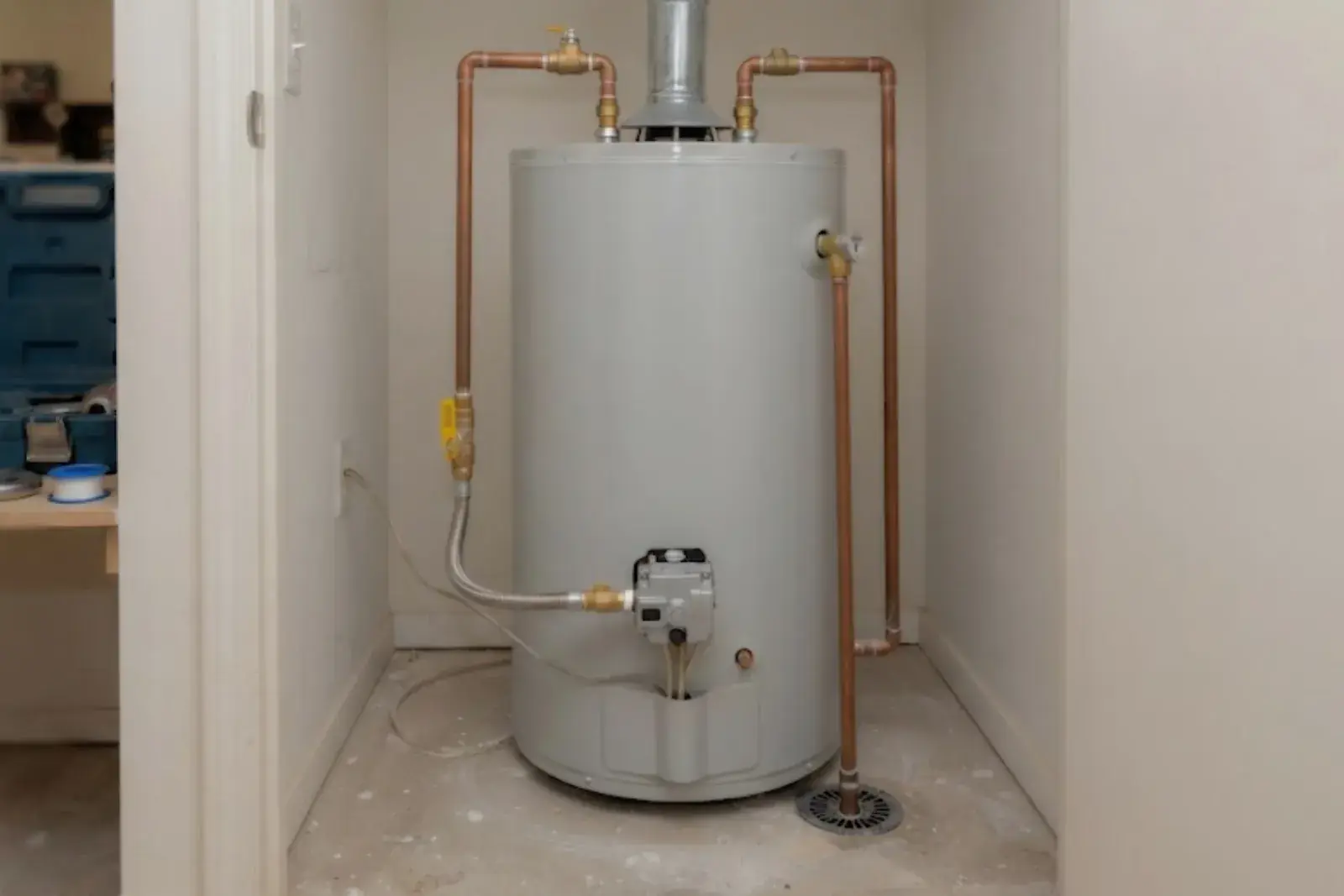
Water heater installation in Sapulpa, OK is the planned job of putting a new water heater into a home for the first time or changing what you already have. Examples are gas to electric, a tank to a tankless unit, or a standard tank to a heat pump model. The work covers more than the tank: fuel connection, vent, water lines, drain pan, relief valve discharge, and the permit.
This page walks through the decisions in the order they come up.
Answered first
Quick answers before the details
A like-for-like install may take part of a day. New gas lines, vent changes, a new circuit or a tankless conversion add time. The permit inspection is scheduled with the city separately.
Often yes, but the new spot needs water lines, a drain, fuel, venting and clearance. The farther it moves, the more pipe, and the plumber checks the route before quoting.
Plumbing permits are separate from building permits and requested through City of Sapulpa Building Inspections by state-licensed, city-registered contractors. Ask your plumber who is pulling the permit.
Start with the fuel you have or can run
Fuel type narrows the field quickly. A home with a gas line near the heater location can use a gas tank or a gas tankless unit. A home with only electric service uses an electric tank or a heat pump model. Adding a gas line where none exists is a bigger project with its own permit and trenching or crawlspace work.
Switching fuel is possible but never free. Gas to electric needs a dedicated circuit and breaker sized to the heater's nameplate, and the panel must have the capacity. Electric to gas needs a gas line, combustion air and a vent. The plumber and, for electrical changes, a licensed electrician look at the panel and the route before quoting.
Where the heater goes
Most water heaters in this region sit in a garage, a utility closet or an attic. Each location has its own rules and risks.
Garage
Gas heaters in a garage are commonly raised on a platform so the burner sits above floor level, where vapors from spilled fuel collect. Vehicle impact protection may also be required, and the manufacturer's manual and local code state what applies. Garages get cold, so insulate the supply lines.
Closet or utility room
A closet needs combustion air for gas models and clearance on all sides for service. Louvered doors or air openings are often part of the plan. Heat pump models need much more open air than a closet gives.
Attic
Attic installs need a drain pan with a piped drain, safe access with a platform and light, and a thought for what is below the ceiling if a leak happens. Weight matters too, since a full tank is heavy.
Ready to plan your install?
A dispatcher is on the line 24/7. Nobody here will pressure you into a repair, and the price is agreed before work starts.
Comparing the options in a table
| Option | Fuel and venting | Space needs | Planning notes |
|---|---|---|---|
| Atmospheric gas tank | Gas line, draft hood, metal flue | Moderate | Needs combustion air |
| Power-vent or direct-vent gas tank | Gas line, fan, plastic vent pipe | Moderate | Vent route can go through a side wall |
| Electric tank | Dedicated circuit, no vent | Small | Simple to place |
| Heat pump (hybrid) | Electric circuit, condensate drain | Large, open air | Cools room, filter care |
| Tankless gas | Larger gas line, special vent | Wall mount | Often condensate drain |
| Tankless electric | Very high amperage circuits | Wall mount | Panel capacity decides |
Venting and combustion air
A gas appliance has to get rid of exhaust and get fresh air to burn. Atmospheric tanks vent by natural draft up a metal flue with a draft hood. Power-vent models push exhaust out with a fan through plastic pipe, and direct-vent models also pull outside air in through a second pipe. Condensing units produce acidic condensate and vent at lower temperatures.
The vent type, pipe diameter, maximum length and number of elbows are set by the manufacturer's installation manual. Do not mix parts between brands. A carbon monoxide alarm in the hall near the bedrooms, tested on the schedule its maker states, is a cheap backstop for any gas appliance.
Gas line sizing considerations
A gas pipe carries only so much fuel, and the load adds up across all appliances. A furnace, range and dryer already draw from the same line. When a new heater is bigger, or a tankless unit is added, the plumber checks the length of the run, the pipe size and the total BTU demand against a sizing chart from the adopted fuel gas code.
Tankless gas units draw a lot at full fire, so the old half-inch branch that fed a tank may be too small. Upsizing a branch means new pipe, a sediment trap (drip leg) and a pressure test. Never connect gas without a shutoff valve within reach of the heater.
Drain pan, relief valve discharge and pressure control
Three small parts do most of the damage prevention.
- Drain pan. A metal or plastic pan under the heater with a drain line to a safe spot, used where a leak could harm finished floors or rooms below.
- T&P relief discharge. The relief valve's pipe runs downhill, is the same size as the valve outlet, ends near the floor or outdoors, and has no cap, valve or threaded end.
- Expansion tank. If the home has a check valve or pressure reducing valve, a small tank charged to house pressure absorbs the swing.
The plumber also sets a service shutoff, a union or flex connector on each line, and a drain valve you can reach.
Code, permits and licensing
Plumbing permits in Sapulpa are separate from building permits, and they are requested through City of Sapulpa Building Inspections by contractors who are licensed by the State and registered with the City. The city says unpermitted work can be fined at least double the permit and inspection fees. The inspector checks the work, so the permit is a second pair of eyes.
The city's page says only that code is state and locally adopted. Ask Building Inspections which edition applies to your job. Verify any plumber's license with the Oklahoma Construction Industries Board at oklahoma.gov/cib. Electric circuit changes may need their own permit from a licensed electrician.
Planning checklist
- Write down the fuel you have now and the fuel you want.
- Photograph the current heater, its data plate, and the space around it.
- Measure the doorway, stairs and clear height to the ceiling.
- List your busiest hour: showers, laundry, dishwasher, and any soaking tub.
- Find the main water shutoff, and test that it turns.
- Check the electrical panel for open breaker spaces if you are going electric.
- Ask how long the permit and inspection will take.
- Ask what the written quote includes for haul-away, pan, expansion tank and venting.
Sizing your new unit
Tank size is only half the picture. The first-hour rating on the EnergyGuide label shows what the heater can supply during a busy hour. For tankless units, flow rate in gallons per minute and the temperature rise decide the pick. Incoming ground water is much colder in January than in summer, so size for winter.
A household that adds a bathroom, a larger tub or a teenager should size for the new load. The plumber can run the numbers from your fixtures and habits.
Local factors in Sapulpa
Sapulpa's drinking water comes from the City of Sapulpa Water Treatment Plant using surface water from Sahoma Lake and Skiatook Lake, per the city's 2025 Consumer Confidence Report. The report does not publish a current hardness figure, so test your tap or ask the city's water utility. If the water is hard, a water treatment plan from water softener and filtration can protect the new unit.
The Tulsa-area normal January low is 28 degrees F. Unheated garages and attics need insulated water lines and a plan for the cold, especially for tankless units and heat pump models that rely on surrounding air.
What decides the price of water heater installation
A clear price comes before work starts. Install quotes vary because the job is not a single product. Call for your real number.
Gas, electric, tankless and heat pump units are priced differently, and capacity and efficiency ratings move the figure inside each type.
A new gas branch, a larger gas pipe, or a dedicated electrical circuit adds labor, pipe and wire, and may involve a second licensed trade.
A side-wall vent, a roof penetration or a long condensing run adds materials and time. Condensate needs a drain or neutralizer.
An attic platform, a garage riser, or a new closet built to hold the unit changes the scope. See also plumbing installation for other fixture work done in the same visit.
Permit fees and the time to schedule inspection are part of the job. Ask whether they are in the quote.
What insurance usually covers
A new installation is typically a homeowner expense, not an insured loss. If you are adding a heater because a failed one flooded a room, a policy may respond to the water damage but not to the heater itself, depending on cause. Read your policy and talk to your insurer first.
Nearby areas
We dispatch from 215 E Dewey Ave in Sapulpa and serve Kellyville, Mounds and Glenpool. Call (855) 575-2890 to talk through your plan.
What to do before the installer arrives
- Clear the area around the old heater and the path to it so the installer can work.
- Know where the main water shutoff and the gas shutoff are and that both turn.
- Take a photo of the nameplate on the old unit, which shows the fuel, size and model.
- Do not light a pilot or restart a unit that smells of gas, and leave the house and call 911 first if you smell gas.
- Ask Building Inspections about the permit now, so nothing is delayed after the old tank is out.
Sources and standards
A new water heater is installed to the ANSI Z21.10.1 listing on the unit, NFPA 54 for gas, the maker's manual for the vent, and the UPC or IPC as adopted locally for the relief valve discharge. Permit and edition questions belong to the city office, and license questions to the state board.
Water heater installation questions
If your plumbing is a closed system, with a check valve or pressure reducing valve, usually yes. The plumber checks house pressure with a gauge to see.
Yes, if the panel has room and capacity for a dedicated circuit. A heat pump model needs open air too. The tradeoff is running cost and recovery time.
Very often. Tankless units burn a lot of gas at full fire, and the old branch may be too small, so the plumber sizes the run.
Haul-away is normal, but confirm it is in the written quote.