
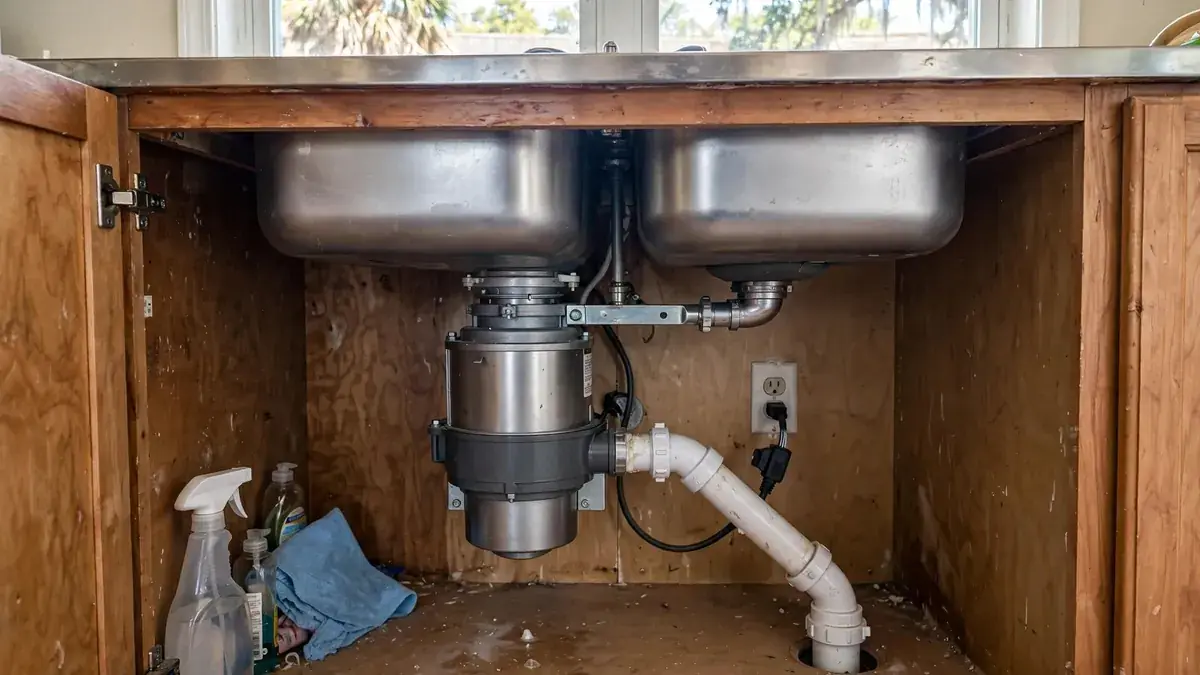
Anyone can buy a garbage disposal, but who may install one in Sapulpa, OK is a split question. The sink and drain connection is plumbing work. The power connection is electrical work. A licensed plumber can handle the plumbing side, and an electrician is the usual choice if new wiring or a new outlet is needed. Whether a homeowner may do it alone is something I could not confirm, so ask City of Sapulpa Building Inspections before doing it yourself.
Three people, three slices of the job
Think of the install as three separate jobs that sometimes get done by one person. Seeing them apart makes the question easier.
| Slice of the job | What it involves | Who normally does it |
|---|---|---|
| Sink flange and mounting | Plumber's putty, mounting ring, snap ring, support the unit's weight | Homeowner or plumber |
| Drain connection | Discharge elbow, trap arm, dishwasher hose inlet | Plumber, or careful homeowner |
| Power | Cord plug into an outlet, or hardwired cable in a junction box | Electrician if wiring is new, otherwise per the unit's instructions |
| Permit questions | Whether the city wants a permit and an inspection | Ask the city |
If you replace an old disposal that is already wired and plumbed, you are mostly swapping one unit for another. That is the lightest version of the job. Adding a first disposal where none existed is a bigger job, because it may need a new outlet or switch.
The decision framework
Answer these in order, and stop at the first line that applies.
- Is there no outlet or switch under or near the sink? Call an electrician for the power, or a plumber who coordinates with one.
- Is the sink drain pipe damaged, corroded or sagging? Have a plumber look first, since a new disposal adds weight and vibration.
- Is this a straight swap of the same size and style? A confident owner may manage it, after checking the permit question with the city.
- Do you have a double bowl sink, a dishwasher and an air gap or high loop to deal with? That is plumber territory for most people.
None of these questions is a legal test. They are practical steps that keep a small job from turning into a flooded cabinet.
Want it installed right?
A dispatcher is on the line 24/7. Nobody here will pressure you into a repair, and the price is agreed before work starts.
What a typical install actually involves
A disposal has an upper mounting assembly that grips the sink from below and a lower motor housing that hangs from it. Getting the seal at the sink flange right is the first catch. A thin rope of plumber's putty or the gasket the maker supplies keeps water out of the cabinet.
Next comes the discharge side. A short outlet on the disposal feeds the trap, and many models have a small side inlet for the dishwasher hose. That inlet usually has a knockout plug inside. If the dishwasher is connected and the plug was never removed, the dishwasher will not drain, and the mistake only shows up on the first cycle.
The electrical connection
Disposals run on household current, and manufacturers handle it one of two ways. Some sell a unit with a power cord that plugs into a switched outlet under the sink. Others are meant to be hardwired through a cable that enters a connection compartment on the underside of the unit.
Wiring inside a cabinet is not a place to guess. The unit's own installation instructions say which method applies, and they are the first source to follow. If the existing outlet or switch is missing, damaged or not dedicated to the disposal, that is an electrician's task. Before you touch any wiring, turn the breaker off and confirm the power is off with a tester.
What goes wrong when it is done casually
Most disposal problems come from small installation shortcuts. A loose mounting ring lets the unit sag and the flange weep. Over-tight plastic parts crack. A trap installed with too much slope or too little slope leaves water standing. A wire nut left uncovered or a cord pinched under the unit can cause shocks or trips.
Another common one is forgetting the dishwasher drain loop. Without a high loop or an air gap, dirty water can flow back toward the dishwasher. If your disposal is already leaking, our garbage disposal repair page describes what a plumber checks and when a unit is past saving.
What the City of Sapulpa and the state say
The City of Sapulpa's Building Inspections page, at City Hall Annex, 424 E. Hobson Ave., says plumbing permits are separate from building permits and must be requested by contractors who are currently licensed by the state and registered with the city. The page treats minor repairs and adjustments as the main exception. It does not say whether a homeowner may install a disposal on their own residence, and I found no homeowner exemption in the state rules I could open.
The Oklahoma Construction Industries Board says on its FAQ page that it does not issue plumbing permits, and the plumbing rules I read from the board mention no garbage disposals.
So the safe course is plain: ask City of Sapulpa Building Inspections at 918-248-5910 before doing it yourself. If you hire out the work, verify the plumber's license with the Oklahoma Construction Industries Board at oklahoma.gov/cib. The city's page also says work done without required permits can be fined at least double the permit and inspection fees, which is the cost of skipping the question.
Choosing a plumber for the install
Ask what the visit includes: new flange seal, trap check, dishwasher connection, power connection and a leak test with water running. Ask who handles the electrical side if a new outlet is needed, and who pulls any permit. Our plumbing installation page describes how fixture installs are usually handled.
Clarity about scope keeps quotes comparable. One bid may include only the unit swap and another may add a new switch and wiring, so line up what each one covers before comparing.
Outside Sapulpa city limits
Rules are set by each town. In Kellyville, which is about 8 miles southwest of Sapulpa, the town hall is the place to ask what applies to a repair at a home there. Mounds lists a Town Building Permits and Inspections office, so call it for questions on work inside the town.
Before you hire or start, a short checklist
- 1Read the unit's instructionsThey say whether it is cord-and-plug or hardwired.
- 2Look under the sinkCheck the outlet, switch, drain pipe and any dishwasher hose.
- 3Call Building InspectionsAsk whether a permit is needed for your exact case.
- 4Decide who does whatPlumber for the drain side, electrician if wiring is new.
- 5Test after installRun water and the unit for several minutes and look for drips.
Sources and standards
The disposal maker's installation sheet governs the mounting and the drain connection, the UPC or IPC governs the drain, and the NEC governs any new wiring. For which code edition the city enforces, the building inspections office is the source, and the state board is the source for licenses.
Garbage disposal installer questions
I could not confirm a homeowner exemption from the state rules or the city page. Ask City of Sapulpa Building Inspections before doing it yourself, and follow the unit's installation instructions.
If an outlet and switch already exist and suit the unit, many installs need no new wiring. If you need a new outlet, a new switch or hardwiring that is not in place, an electrician is the usual choice.
The city requires permits for plumbing work done by state-licensed, city-registered contractors, with minor repairs and adjustments as the main exception. Whether a disposal swap counts as minor is a question for the city.
The knockout plug in the dishwasher inlet may still be in place. A plumber can check the plug, the hose and the high loop.
The 24/7 line at (855) 575-2890. A dispatcher can send a licensed plumber, and you can shut the water off under the sink while you wait.