
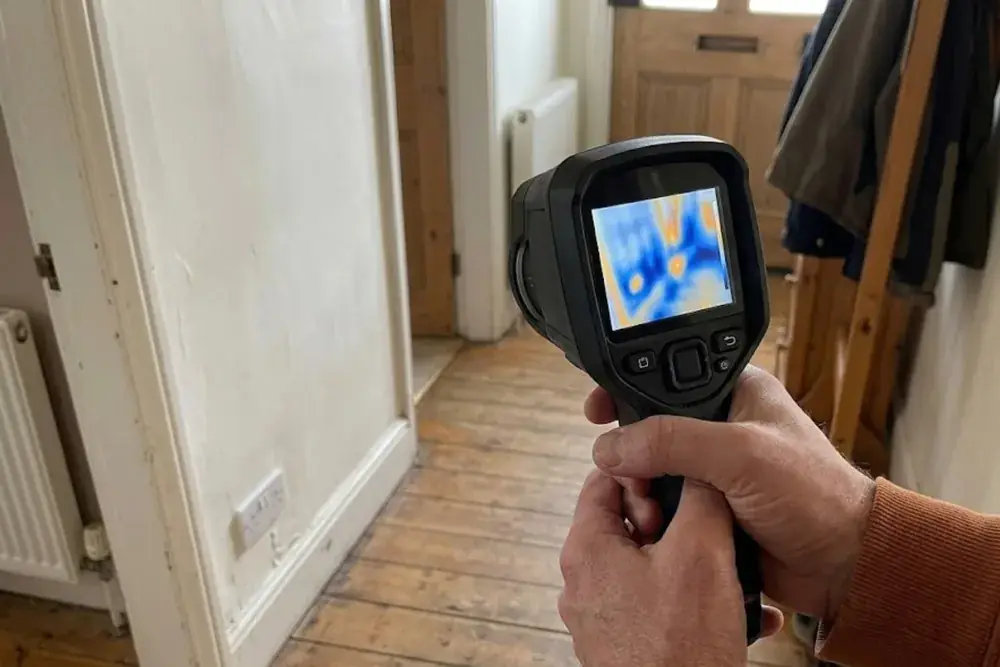
Here is the short answer on infrared camera leak detection in Sapulpa, OK: a thermal camera can point to a spot where something is wrong, but it does not see water and it does not prove a leak by itself. It reads surface temperature. A wet wall, a warm slab line or a cold patch behind drywall can all show up as a different color, and each of those can have a cause that is not a leak.
What a thermal camera really measures
An infrared camera turns heat radiating off a surface into a picture, usually with warmer areas in brighter colors. It cannot look through a wall. It sees the face of the wall and how warm or cool that face is compared with the area around it.
Water changes surface temperature in two ways. Wet material evaporates moisture and cools. A hot water line leaking into a slab or wall warms the material above it. Both effects are subtle, often only a degree or two, so conditions in the room matter a great deal.
That is why the same image can mean different things. A cold stripe on a ceiling might be a leak above, or it might be missing insulation. A warm slab line might be a hot water leak, or it might be a heating duct.
Where thermal imaging helps
Thermal imaging works best as a scanning tool, not a verdict. It narrows a search that would otherwise mean opening a lot of drywall.
- Finding the area to test around a damp ceiling stain before cutting a hole.
- Tracing a warm path on a floor that may follow a hot water line, a common clue for a slab leak.
- Showing where wet insulation has cooled the wall surface.
- Documenting a problem for a landlord or an insurance adjuster.
- Checking whether a repaired area is drying.
Want your real number? Call the line and describe what you see.
A dispatcher is on the line 24/7. Nobody here will pressure you into a repair, and the price is agreed before work starts.
Where it fails
Be wary of anyone who sells thermal imaging as magic. These are the common limits.
- It cannot see inside a thick slab, behind metal siding or through foil-faced insulation.
- Cold water lines in a cool house often leave no temperature difference at all.
- A small drip may not change the surface enough to register.
- Sun on an exterior wall, a vent or a lamp can create false readings.
- Evaporating damp from a past leak can look like an active one.
When a scan is clear, that is not proof there is no leak. It means the camera did not find a temperature pattern.
Which tool answers which question
Leak detection is a stack of methods, and each answers a different question. The leak detection service uses the combination that fits the symptom.
| Question | Tool that answers it | What it tells you |
|---|---|---|
| Is water leaking at all? | Meter test and pressure test | Whether the system loses water with everything off |
| Which line is leaking? | Isolation test, shutoff valves | Hot, cold, irrigation or main supply |
| Where is the damp area? | Thermal camera, moisture meter | Likely area to investigate |
| Where exactly is the leak? | Acoustic listening, tracer gas | Spot to open or dig |
| Is the sewer line leaking? | Drain camera | Cracks or joint failures in the drain |
Moisture meters are the quiet partner of the thermal camera. A pin or pinless meter reads moisture in drywall, wood and plaster, and it can confirm that a cold spot on the camera is truly wet. Acoustic listening picks up the hiss of pressurized water at a pipe, and tracer gas, a harmless mix of hydrogen and nitrogen, escapes at the leak where sensors can find it.
Conditions that make a scan work better
A good scan depends on setup, and a few things you can do raise the odds.
- Let the house sit at a steady temperature for several hours before the visit.
- Turn off running water, appliances and the irrigation system.
- Clear furniture away from the walls and floor area in question.
- Note when the symptom started and where, such as warm floor, damp baseboard or stain.
- Take photos of any stain with a date, so the plumber can see change.
The plumber may also ask you to run hot water at a fixture for a few minutes so a warm line shows up on the camera.
Sapulpa details worth knowing
Your water comes from the City of Sapulpa Water Treatment Plant, which treats surface water from Sahoma Lake and Skiatook Lake, according to the city's 2025 Consumer Confidence Report. The water is delivered by the city, so a leak on your side of the meter shows up as consumption on your city bill.
City Utility Billing at City Hall, 425 E. Dewey Ave., reads meters in 1,000-gallon units, per the city's Utility Billing page. That unit size is useful. A leak of a few gallons a day may not move a dial much, but a steady drip over a week will. Use the meter test in your own house to confirm a loss before paying for any scan.
The coldest January nights matter for leaks too. The National Weather Service gives Tulsa a January normal low of 28 F for 1991 to 2020, and in February 2021 lows reached about minus 13 to minus 14 F. Pipes in exterior walls and crawl spaces are where cold damage starts, and a thermal scan on a cold day can help find a split line that is leaking behind a wall.
For neighbors in Kellyville, water comes from Creek County Rural Water District No. 1, not the City of Sapulpa, so billing and meter questions go to the district. Homes in Mounds work with a different rural water district through the Town, so ask Town Hall which one applies to you.
What happens after the camera
The thermal image only starts the work. The plumber should explain what it pointed to, then confirm with a second method before anything is cut. You should hear which tool found what, and why that area is suspect.
A confirmed leak goes into one of two plans. A line in an accessible wall or ceiling is a small repair. A line in or under a slab may be fixed by an access hole, a reroute above the slab or a replacement of that line. The plumber lays out the trade-offs, and any repair that needs a permit goes through City Building Inspections by a licensed, registered contractor.
Keep photos and the scan report. If the leak damaged your home, an insurer or landlord will ask for them. Check your policy to see what it does and does not cover for hidden leaks.
Sources and standards
Thermal imaging is a screening tool, and its results are confirmed with moisture meters, pressure tests or acoustic listening before anyone opens a wall, as the camera makers' own guidance advises. For which code edition the city enforces, the building inspections office is the source, and the state board is the source for licenses.
Frequently asked questions
No. It reads the surface temperature of the wall and shows patterns that may mean moisture behind it. Every pattern has to be confirmed by another method.
Sometimes. A hot water leak can warm the slab surface, which a camera may show. Cold water leaks and thick or covered flooring can hide the pattern, so acoustic listening is usually added.
Not always. A meter test often tells you whether you have a leak, and listening or pressure tests find it. A thermal scan is one more tool for hard cases.
Turn off every fixture and appliance, then read the meter and check it again after an hour or two. If the reading moves or the leak indicator spins, water is escaping somewhere. Utility Billing at 918-224-6220 can answer meter questions.
No. A sewer inspection uses a waterproof camera on a cable inside the pipe. A thermal camera reads surfaces and cannot see inside a drain.
If your bill climbed or a floor feels warm, call the 24/7 line at (855) 575-2890 and a dispatcher will book a licensed plumber to run the right tests.