
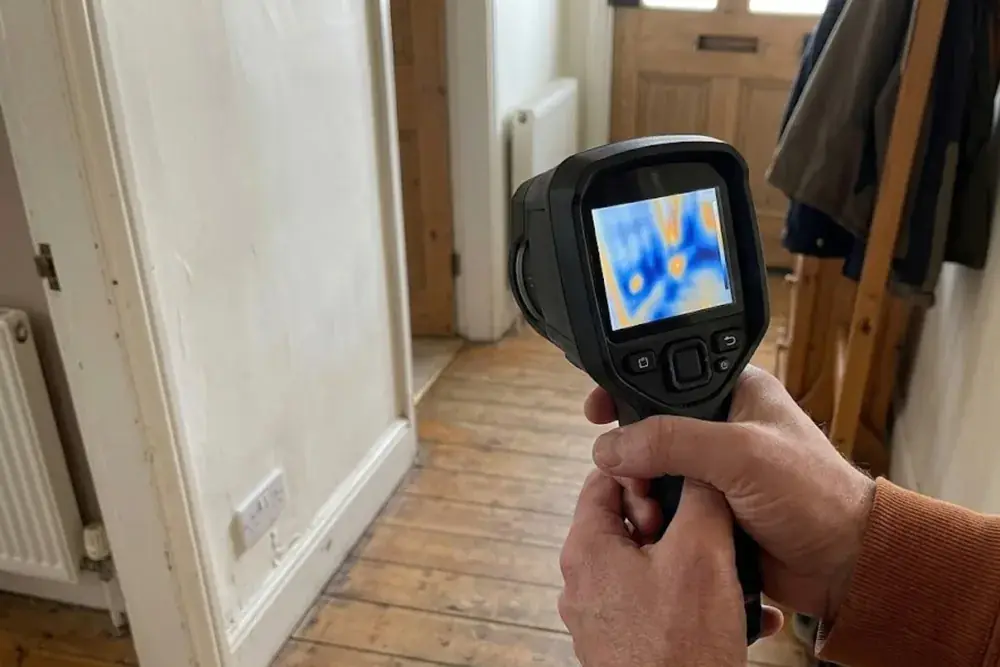
Your water bill is higher and nobody changed a habit. Run a ten-minute check before blaming the lawn, because a hidden leak in a Sapulpa, OK home shows on the meter long before it shows on a wall. A hidden leak is any loss of water you cannot see, such as a pinhole in a line under the slab, a running toilet flapper or a split in the yard line. The meter test below tells you whether you have one.
Signs that water is going somewhere it should not
No single sign proves a leak, but several together are hard to ignore. Look for these around the house and yard.
- A water bill that rises with no change in how you live.
- A meter dial or leak indicator moving when every tap is off.
- Water pressure that has dropped across the house.
- A warm patch on the floor, or a hot water tank that seems to run constantly.
- A musty smell, peeling paint, bubbled drywall or a stain that grows.
- Baseboards or flooring that feel soft, cup or lift.
- A green, soft or sunken stripe in the yard that stays wet in dry weather.
- The sound of water running in a wall when the house is quiet.
Keep notes with dates. When a plumber arrives, the history of a stain or a bill is often as helpful as the stain itself.
The water meter leak test, step by step
This test shows whether water is leaving your system. It takes no tools beyond a flashlight and a pen.
- 1Stop all useTurn off the dishwasher, washer, ice maker, irrigation and humidifier, and make sure nobody flushes or runs a tap.
- 2Find the meterIt sits in a box near the street or property line. Lift the lid carefully and watch for insects.
- 3Read the leak indicatorMany meters have a small triangle or star dial that spins at even a slow flow. If it moves, water is flowing.
- 4Write down the readingNote the full register, including the last digits, and the time.
- 5Wait and re-checkCome back after an hour or two with no water used. If the number moved, you have a leak. If it did not, check again after a longer period, such as overnight.
- 6Split the houseTo find the side of the problem, shut the main valve at the house and watch the meter. If it still moves, the leak is in the yard line between the meter and the house. If it stops, the leak is inside.
The toilet dye test catches the most common culprit. Put a few drops of food coloring in each tank and wait fifteen minutes without flushing. Color in the bowl means the flapper leaks, which can waste a lot of water without any noise.
Want your real number? Call the line and describe what you see.
A dispatcher is on the line 24/7. Nobody here will pressure you into a repair, and the price is agreed before work starts.
Read the result and decide
| What the meter did | What it points to | Next step |
|---|---|---|
| Indicator still, reading unchanged | No steady leak right now | Check for intermittent causes, like irrigation timers |
| Moves with house main shut | Leak in the yard line or at the meter side | Call a plumber for a water line repair assessment |
| Stops with house main shut | Leak inside the house | Dye test toilets, then check fixtures and water heater |
| Moves only when hot water is used | Hot line or water heater area | Call, and watch for warm floors |
| Moves only at certain hours | Irrigation, ice maker or a timer | Inspect those systems |
If you cannot find the cause, a professional leak detection visit uses pressure tests, listening gear and moisture readings to pinpoint the spot.
What a homeowner can safely do, and when to call
You can shut off the main valve, run the meter test, do the dye test, check under sinks, and look at the water heater's pan and fittings. You can also take dated photos and print your recent bills.
Call a plumber when the meter moves with the main closed, when you suspect a line under a slab, when a ceiling is sagging, or when a leak is near electrical outlets. Water near electrical panels or outlets is a reason to stay out of the area and turn off power at the breaker only if you can reach the panel without standing in water. If you smell gas, leave the house and call 911 first.
Sapulpa water bills and leak adjustments
The City of Sapulpa Utility Billing office is at City Hall, 425 E. Dewey Ave. The city's Utility Billing page says staff provide leak adjustments as part of its collection efforts. It does not lay out the eligibility rules or a request process, so the practical move is to call Utility Billing at 918-224-6220 and ask.
Here is what to ask, in order:
- Does the city offer an adjustment for a leak on my account, and for what kind of leak?
- What proof does the city want, such as a plumber's invoice or a photo of the repair?
- How far back does an adjustment reach, and is there a deadline after the repair?
- Does it apply to the water charge, the sewer charge or both?
- Should I keep paying the current bill while the request is reviewed?
Keep a copy of the repair invoice, the meter reading from before and after the fix, and the name of who you spoke to. The city bills water from meters read in 1,000-gallon units, so a repaired leak should show up as a drop on the next reading cycle.
The city also publishes its drinking water report each year, and its 2025 Consumer Confidence Report notes the lead-and-copper basics for home plumbing and offers the service line inventory to customers who call 918-224-3040. If you are chasing a leak in an older yard line, that is a useful call to make at the same time.
Where your town may differ
Not every address near Sapulpa buys water from the city. In Kellyville, water comes from Creek County Rural Water District No. 1, so a bill question goes to the district, not City Hall. Homes in Glenpool buy water through the city of Glenpool, whose own water office handles billing and meter questions. Ask your utility the same five questions above.
After the repair
Run the meter test again once the repair is done. A stable reading confirms the fix and gives you the proof you may need for a bill adjustment. Watch the next two bills, because a drop is the clearest sign that the leak is gone. If the line was old, ask the plumber whether other sections are worth replacing while the wall or yard is open.
Sources and standards
The meter test described here is the same basic check the EPA's WaterSense program recommends for finding household leaks, and a plumber's written findings carry more weight with an insurer than a homeowner's notes. Ask City of Sapulpa Building Inspections which edition applies and whether a permit is needed.
Frequently asked questions
A steady drip can waste many gallons a day without any visible sign, and a failed toilet flapper can waste more. The meter test is how to see it.
The city says Utility Billing staff provide leak adjustments, but the published page gives no rules. Call 918-224-6220 and ask what applies to your situation before you assume anything.
Many meters have a leak indicator or a low-flow display, and the steps are the same. If you cannot find an indicator, compare two readings taken an hour apart with all water off.
A slab leak is in a pipe under or in the concrete floor, often with warm spots on the floor. A yard line leak is outside, between the meter and the house, and shows as a wet area or low pressure. Both are covered by a plumber's tests.
Where the city's responsibility ends and yours begins is not spelled out on the city's pages, so ask Utility Billing or Public Works about your address. A water main break on a street is a city matter, and the after-hours line is 918-224-3862.
If the meter keeps moving, call the 24/7 line at (855) 575-2890 and a dispatcher will schedule a licensed plumber to find the leak.